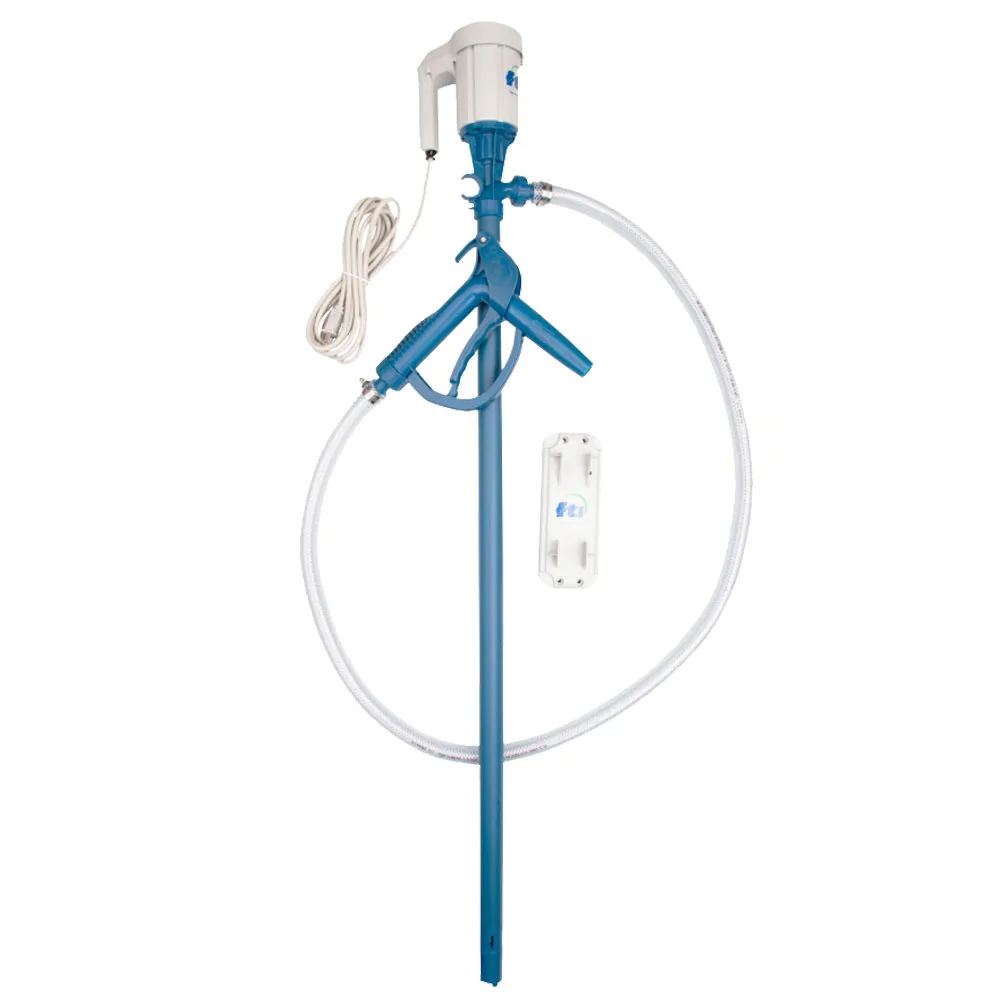
How to Choose a Drum Pump
A drum pump (also sold as a barrel pump for chemicals) is a motor plus an immersion tube. The motor sits on the bung. The tube reaches the liquid. A rotor or impeller at the bottom pushes product out the discharge. That sounds simple until the wrong plastic meets the wrong acid, or a 39 inch tube bottoms out in a tote.
We stock Lutz drum and container pumps as the primary line for this job: pump tubes, motors, complete sets, flow meters, and parts. PumpCatalog also carries Finish Thompson drum pumps if your plant already standardizes on that brand (EF sealless, PF sealless). The selection method below is the same either way.
How to choose a drum pump: write down the liquid (name, concentration, temperature, viscosity), the container (carboy, 55 gallon drum, IBC tote), the discharge path, and whether the area is classified. Then pick the tube material, the hydraulics, the motor, and the accessories as one assembly. Send us the SDS if any of those are unknown.
Match the Liquid to the Tube
Chemical class, concentration, and temperature pick PP, PVDF, 316 stainless, or Hastelloy. Flammables also pick a Zone 0 metal tube and an approved motor.
Match Flow, Head, and Viscosity
Rotor (R) for open, high-flow transfer. Impeller (L) for head, long hose, meters, and nozzles. Past a few thousand cps, a progressive cavity tube replaces a centrifugal one.
Match Length, Motor, and Discharge
Measure immersion depth. Then pick electric or air (and the approval), plus hose, nozzle, meter, and bracket.
Tube Materials by Chemical Class
The outer tube is only the first wetted part. Shaft, impeller, bearings, seals, hose, nozzle, and meter all see the same liquid. Lutz's chemical resistance table is rated at room temperature (68 F). Concentration, heat, water ingress, and impurities all change the rating. The table below is a screening map from Lutz drum-pump literature, not an approval for your batch.
Polypropylene (PP)
Class: Aqueous acids and alkalis, phosphates, sulphates, paints, water, oils. Not for flammable liquids.
Temp: 122 F
Flammables: No
PVDF
Class: Concentrated acids and alkalis. Catalog examples: sulphuric, nitric, hydrofluoric, chromic, phosphoric 95%, chlorine water. The Lutz resistance table also rates PVDF for sodium hypochlorite.
Temp: 212 F
Flammables: No
316 Ti stainless (SS)
Class: Solvents and many flammables. Catalog examples: gasoline, alcohols, acetone, acetates, ethers, paints, vegetable oils.
Temp: 212 F
Flammables: Yes, Zone 0 with an approved Lutz motor
Hastelloy C (HC-4, 2.4610)
Class: Extremely corrosive and flammable service. Catalog examples: bromine, chlorosulphonic acid, butyl chloride, chlorine water.
Temp: 248 F
Flammables: Yes, Zone 0 with an approved Lutz motor
Temps and Zone 0 notes: Lutz Drum and Container Pumps brochure, pages 6 to 13 (file_url documents/lutz-pumps-drum-and-container-pumps.pdf). SKUs and housing/shaft fields confirmed on the matching pump-catalog product rows.
What the Lutz resistance table actually changes
A material name on the tube is not enough. Lutz's own resistance table (Lutz Pumps Inc., Norcross) rates each tube construction, not just the polymer. Two snapshots that catch buyers:
- Hydrochloric acid (10%, 30%, and saturated): ratings split across PP constructions. A PP housing with the wrong shaft can be listed non-resistant while a PP/Hastelloy-shaft construction is listed resistant. Do not order "PP for HCl" without checking the shaft.
- Sulphuric acid: 40% and 80% show mixed PP ratings; 98% (SG 1.84) is listed non-resistant on the PP constructions and resistant on PVDF. That is why concentrated sulfuric usually starts on PVDF, not PP.
- Sodium hydroxide 10% to 50%: PP constructions are listed resistant (some need a special EPDM seal). Aluminum is not the starting screen for caustic.
- Sodium hypochlorite 10% to 20%: the resistance table lists every PP construction non-resistant and rates PVDF resistant. Start bleach service on PVDF and confirm the exact tube construction against the SDS.
- Petrol / petroleum ether and pure acetone: marked Ex. PP and PVDF constructions are listed non-resistant. Stainless and Hastelloy constructions are the screen, plus an approved motor and conductive hose.
A resistance chart is a screen, not a stamp
Lutz states the ratings were assessed at room temperature and that corrosion changes with concentration, temperature, impurities, and water entry. The table is a recommendation, not a warranty. If you cannot verify every wetted part at your real conditions, send the Safety Data Sheet and we will check the construction before you buy.
PP and PVDF tubes are not for flammable liquids
The Lutz PP and PVDF tube pages both warn: the drum and container pump must not be used for flammable liquids. Zone 0 metal tubes are stainless steel or Hastelloy C only, used with an explosion-protected motor (Silver Star ME I 6 or MD1xL/MD2xL in Lutz's bonding diagram).
Motor Options: Air vs Electric
Pick the motor after the tube. It has to supply torque for the density and viscosity, match your power (or air), and carry the right approval for the room. Lutz motors and tubes are sold separately and mix within compatible families. Confirm the pair by part number. Browse Lutz pump motors or start from a complete pump set when the listed package matches the liquid and container.
Electric (corded)
The everyday plant choice when the liquid is non-flammable and you have 120 V (or 230 V) nearby. Open-drip B36 / MI 4 is 0.85 HP at 120 V. TEFC B55-T-5 / MA II 5 is 0.68 HP at 120 V. Explosion-proof ME I 6 Silver Star is 0.5 HP at 120 V, Class I Groups C and D, Class II Groups F and G.
HP, voltage, and enclosure confirmed on Lutz brochure page 4 and on product rows 0030-002, 0060-004, and 0040-200.
Compressed air
Use when you have plant air, want no electric spark at the motor, or need more viscosity capability on a progressive cavity tube. Catalog MD-1 / MD-2 (Ex) motors are 0.54 HP, 87 PSI, 32 CFM. The later MD1xL / MD2xL series is an oil-free 1000 W air motor, ATEX certified, listed to 100,000 mPas when driving a suitable high-viscosity pump.
MD-1/MD-2 figures: brochure page 4 plus SKUs 0004-086 and 0004-093. MD2xL 1000 W / 6 bar / 100,000 mPas / ATEX: Lutz MDxL brochure (documents/lutz-md2xl-compressed-air-motors.pdf).
B2 Vario (lab and small fills)
Variable-speed 180 W, 110-120 V, 60 Hz motor with a sealless PP or 316 stainless tube. Published maximums: 18.5 GPM, 21.3 ft of head, 300 cps, specific gravity 1.3. Tube lengths 19, 27, and 39 inch cover small vessels through a 55 gallon drum.
Lutz B2 Vario USA brochure and product rows 0201-520 (19 in) and 0201-522 (39 in), both listing capacities-gpm 18.5.
Explosion-proof and ATEX
Flammable service needs a Zone 0 metal tube plus an approved drive. The US catalog motor page lists the ME I 6 Silver Star (electric, UL Class/Division groups above) and the MD-1/MD-2 Ex air motors; Lutz's current resistance-table bonding diagram pairs Zone 0 tubes with ME I 6 or MD1xL/MD2xL. Lutz marks the MDxL motors as ATEX certified. An ATEX plate does not by itself prove acceptance for a US Class/Division location. Match the nameplate to the site classification.
Zone 0 warning and ME I 6 / MD1xL / MD2xL pairing: Lutz chemical resistance table bonding diagram.
Air may drive the motor. It must never pressurize the drum.
Compressed air on an MD-series motor is the power source. Putting air pressure on the product container to force liquid out is a different (and unsafe) method. For flammable liquids, bond and ground the metal tube, use conductive hose and fittings, and a stainless nozzle, as shown on Lutz's bonding diagram.
Cordless is not classified-area approval
A battery motor still stores electrical energy. If the transfer area is classified, the exact equipment must be approved for that location. Do not treat a cordless lab pump as a shortcut around explosion-proof or ATEX requirements.
Flow Rate and Viscosity Limits by Tube and Motor
Lutz publishes two hydraulic styles on the 41 mm (and 42 mm Hastelloy) centrifugal tubes: R is the axial rotor (higher free flow, lower head). L is the radial impeller (lower flow, more than double the head on PP). R does not mean radial. The figures below are brochure maximums for the B 28 electric motor pairing unless noted. Flow and head were determined with water at 68 F. Viscosity is listed as continuous / intermittent and was determined with oil.
PP or PVDF 41-R (with B 28)
Flow: 48 GPM
Head: 33 ft
Viscosity: 400 / 600
SG / temp: SG 1.5; PP 122 F, PVDF 212 F
PP or PVDF 41-L (with B 28)
Flow: 24 GPM
Head: 69 ft
Viscosity: 1000 / 1200
SG / temp: SG 2.0; same temps as above
SS 41-R or HC 42-R (with B 28)
Flow: 54 GPM
Head: 40 ft
Viscosity: 600 / 1000
SG / temp: SG 1.5; SS 212 F, HC 248 F
SS 41-L or HC 42-L (with B 28)
Flow: 28.5 GPM
Head: 66 ft
Viscosity: 1000 / 1200
SG / temp: SG 2.0; same temps as above
B2 Vario PP-SL or SS-SL
Flow: 18.5 GPM
Head: 21.3 ft
Viscosity: 300 cps
SG / temp: SG 1.3
B70V-SR progressive cavity (with MD-2 air motor)
Flow: 13 GPM
Head: 200 ft (87 PSI)
Viscosity: 50,000 cps
SG / temp: 284 F
Centrifugal rows: Lutz Drum and Container Pumps brochure, pages 6 to 7 (B 28 column). B2 Vario: USA brochure plus SKUs 0201-520 / 0201-522. B70V-SR: brochure page 19. MD2xL literature lists the air motor itself to 100,000 mPas; that is a motor capability on a suitable progressive cavity pump, not a centrifugal tube rating.
Do not stack every maximum on the data sheet
Maximum flow, head, viscosity, and density are boundary values. No pump hits all of them at once. A weaker motor cuts every number. The B 36 / MI 4 column on the same brochure drops PP 41-R to 45 GPM / 31 ft / 300/600 cps. Size to the operating point, then check the curve for the exact tube and motor.
When viscosity climbs past what the selected centrifugal tube is rated for, do not buy a bigger electric motor and hope. That is the Lutz B70V progressive cavity job (smooth, higher pressure, up to 50,000 cps with the MD-2 in the brochure). The later MD2xL air motor brochure extends motor-side viscosity capability to 100,000 mPas on a matching high-viscosity pump.
Size the Tube Length to the Container
Do not order "a 55 gallon drum pump" by the label on the drum. Measure from the support plane (the bung, adapter, or bracket the pump rests on) down to where you want the intake. Leave clearance above the drum floor. A tube jammed on the bottom wears the foot and pulls sludge.
Carboy, pail, or small vessel
Lengths: B2 Vario 19 in or 27 in
Notes: B2 Vario is offered in 19, 27, and 39 inch for small vessels up to 55 gallon drums.
55 gallon drum (2 in bung)
Lengths: 27, 39, or 47 in (measure first)
Notes: Standard MMS/MSL PP, PVDF, and SS tubes: 27, 39, 47 in. RE 88 complete-drainage tubes use the same three lengths and a 41 mm tube that fits a 2 in bung.
IBC tote or tall tank
Lengths: 47 in, then 55 to 78 in sealless
Notes: MSL-only PP and SS extra lengths: 55, 59, 63, 67, 78 in. Lutz lists IBC pumps in lengths up to 78 in. Hastelloy SL-HC stock lengths in the brochure are 39 and 47 in (special lengths on request).
Viscous or sanitary drum
Lengths: B70V 39.4 in or 43.3 in
Notes: B70V-SR tubes: 1000 mm (39.4 in) or 1100 mm (43.3 in), 54 mm (2.12 in) diameter. Sanitary B70V-H-SR: 1100 mm, Tri-Clamp 2 in.
Lengths: Lutz Drum and Container Pumps brochure (PP page 9, PVDF page 10, SS page 12, HC page 13, RE 88 page 15, MP page 17, B70V pages 18 to 19, B2 Vario page 21). IBC 78 in note: brochure page 2.
Measure before you order
Have these dimensions on the RFQ. Guessing from the drum stamp is how you buy a tube that is two inches too short.
Accessories That Matter
Published flow is a brochure maximum with water. Hose, elevation, fittings, a meter, and a nozzle all consume head. Size the discharge as part of the pump, not as an afterthought. Lutz parts live under pump parts; meters have their own flow meter category.
Flow meters
The Lutz TR90 turbine meter (PP or PVDF) is listed at 1.3 to 23.8 GPM, 0.8 to 40 cps, 58 PSI at 68 F, 14 to 122 F. PP examples: glycol, ferric chloride, hydrochloric acid, phosphoric acid. PVDF examples: chlorine solution, nitric acid, sulphuric acid. Higher viscosity belongs on a different meter family (HDO / oval-gear style), not a turbine.
Nozzles
A hand nozzle gives control and is also a flow thief. B2 Vario sets ship with a PP nozzle and 5 ft of PVC hose. We stock the B2 PP 3/4 in nozzle as 0201-215. Flammable service needs a conductive stainless nozzle, not a plastic one. Positive-displacement tubes (B70V) need a bypass if the nozzle can close against the pump.
The fast path when a listed package matches your liquid, container, voltage, and discharge. A set is not a blanket chemical approval. Confirm every wetted part.
Watch for: Do not assume the hose and nozzle in the set survive a chemical the tube can handle.
171 active tubes on the pump-catalog storefront, including the PP, PVDF, 316 stainless, Hastelloy, RE 88, MP, B2 Vario, and B70V constructions cited above.
The product-type node for drum pumps across brands (3,545 products), if you need to compare Lutz against Finish Thompson, AMT, Yamada, or ARO packages.
Need a Lutz drum pump and already know the part number? Search the SKU (for example 0201-522 is the B2 Vario PP-SL 39 inch). If the plate is worn, send photos.
Common Selection Mistakes
Ordering PP because "it is for chemicals"
PP covers a wide aqueous acid/alkali window at or below 122 F. Concentrated sulfuric, nitric, hypochlorite, and hydrofluoric service is often a PVDF job. Flammables are never a PP or PVDF job. Check the shaft and seal, not just the housing.
Treating chemical resistance as explosion protection
A stainless tube can love a solvent and still be unapproved for the room. Zone 0 tubes are stainless or Hastelloy only, paired with ME I 6 or an Ex air motor, plus bonding, grounding, and conductive hose.
Quoting catalog GPM as the fill time
Brochure flow is a maximum determined with water at 68 F. Your viscosity, hose, meter, and nozzle all cut it. A B2 Vario set includes a nozzle on purpose; expect delivered flow well below 18.5 GPM.
Picking length from the drum stamp
Adapters, cover plates, and IBC cages change the support plane. Standard drum tubes are 27, 39, and 47 inch. Totes often need the sealless 55 to 78 inch range. Measure.
Forcing viscosity through a centrifugal tube
PP 41-L tops out around 1000/1200 cps on the B 28 column. B70V-SR with an MD-2 is listed to 50,000 cps. The MD2xL motor brochure's 100,000 mPas figure is not a license to run resin through a 41 mm rotor.
Frequently Asked Questions
What is a drum pump, and is a barrel pump the same thing?
Yes. Drum pump and barrel pump are the same class of portable transfer pump: a motor on a bung and a tube in the container. On this site the Lutz line lives at /lutz. The type-tree node is /types/positive-displacement-pumps/drum.
What barrel pump material do I need for chemicals?
Start from the SDS, not the word "chemical." Aqueous acids and alkalis at moderate concentration and at or below 122 F often start on polypropylene. Concentrated acids (sulphuric, nitric, hydrofluoric, chromic) and sodium hypochlorite start on PVDF. Solvents and flammables start on 316 stainless or Hastelloy C with an approved motor. Confirm every wetted part on the Lutz resistance table at your concentration and temperature.
How do I choose a Lutz drum pump?
Liquid first (tube material and seal), then hydraulics (R rotor vs L impeller, or B70V if viscous), then tube length from a measurement, then motor (electric, air, explosion-proof), then hose, nozzle, and meter. We can build that list from an SDS and a photo of the container. Use /contact.
Air motor or electric motor for a drum pump?
Electric is the default on non-flammable duty when you have 120 V. Air (MD-1/MD-2 or MD1xL/MD2xL) is the default when you have plant air, want no electric spark at the motor, or need the high-viscosity progressive cavity pairing. Flammable indoor transfer needs the approved motor, not whichever cord is handy.
What length drum pump tube fits a 55 gallon drum vs a tote?
Most 55 gallon drums land on a 39 or 47 inch Lutz tube after you measure from the bung. B2 Vario also offers 19 and 27 inch for carboys and pails. IBC totes often need 47 inch or the sealless 55 to 78 inch PP/SS lengths. Hastelloy brochure lengths are 39 and 47 inch; ask for a special length if the tote is taller.
Can I use a polypropylene drum pump for a flammable solvent?
No. Lutz forbids PP and PVDF tubes on flammable liquids. Use a Zone 0 stainless or Hastelloy tube, an ME I 6 or Ex air motor, conductive hose and nozzle, and a bonded/grounded path that matches the site classification.
When to Call an Expert
This guide is the same checklist we use on the phone. Call or write if any line is still fuzzy:
You cannot verify compatibility for the tube, shaft, seal, hose, nozzle, and meter at the real concentration and temperature.
The liquid is flammable or the room is classified. We will match the approval, not just the alloy.
Viscosity is high enough that you are choosing between an L impeller and a B70V progressive cavity tube.
You are replacing a Lutz motor or tube and the nameplate uses an older family name (B36 / MI 4, B55 / MA II, ME I 6, MD-1/MD-2).
The discharge run includes a long hose, a meter, and a closed nozzle, and you want delivered flow (not brochure GPM) before you order.
Talk to a Drum Pump Specialist
Send the SDS, container size, required flow, power or air supply, and area classification. We will spec a Lutz tube, motor, and discharge package (or tell you when a Finish Thompson or ARO drum package is the better fit).