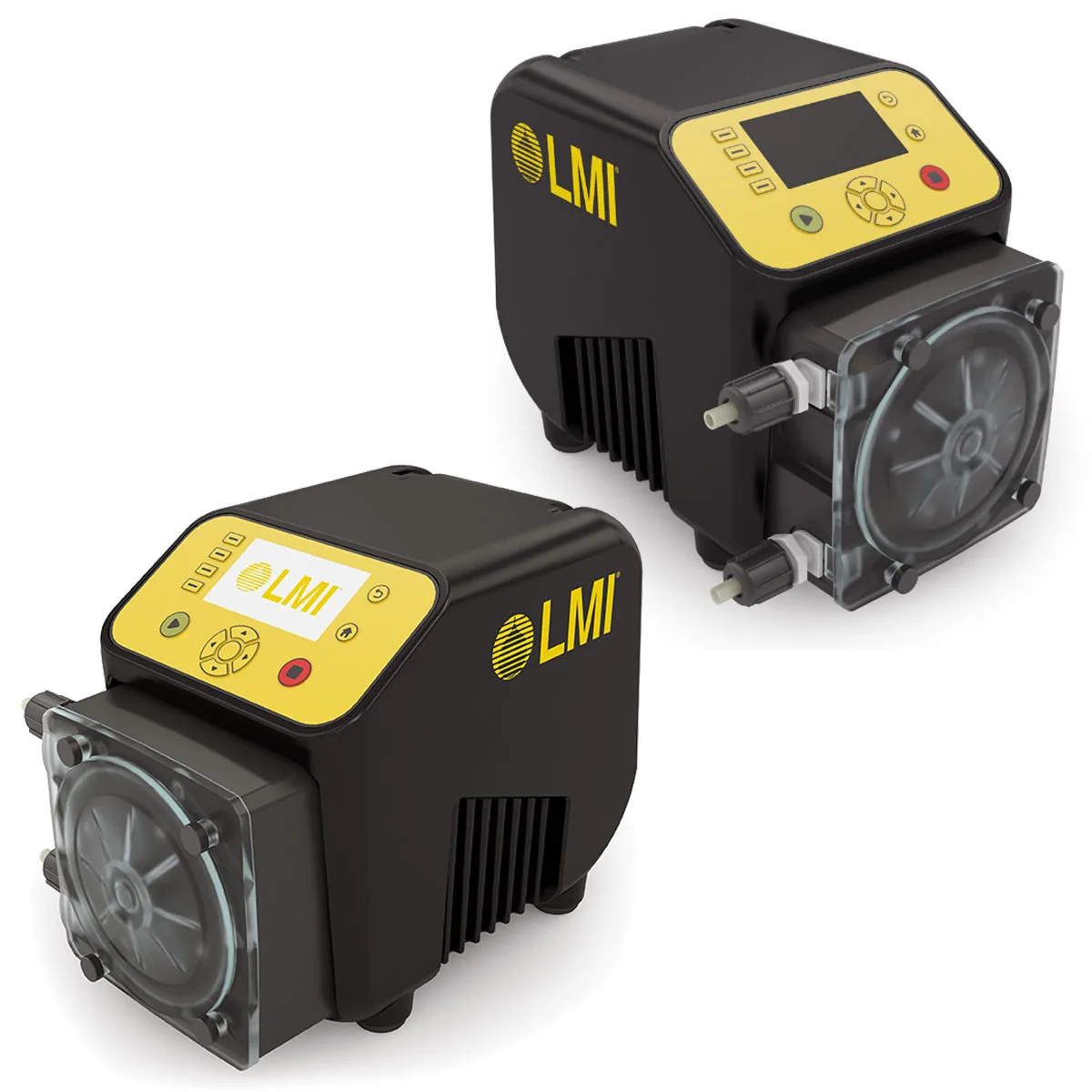
How a Chemical Metering Pump Works
A chemical metering pump is a positive-displacement feeder. Each stroke moves a known volume of chemical into a process line or tank. That is a different job from a centrifugal transfer pump. You are not moving water across a plant. You are holding a dose: mg/L of chlorine, a pH setpoint, a coagulant residual. If the stroke volume or the stroke rate is wrong, the chemistry is wrong, and the rest of the plant pays for it.
LMI (Milton Roy / Ingersoll Rand) describes the mechanism the same way we explain it on a quote call. The drive moves a diaphragm (or, on a peristaltic unit, squeezes a tube). The suction check opens on the back stroke and fills the liquid end. The discharge check opens on the forward stroke and pushes that volume into the injection point. Flow is stroke volume times strokes per minute. Pressure rating is whatever the liquid end and drive can hold against the process.
Three questions decide the pump before you look at a model number:
- How much chemical, at what pressure? That is GPH (or GPD) at the injection PSI, not the nameplate on the last pump that failed.
- How far must output swing? Overnight demand vs peak is turndown. A pump that only lives at 90% of max will overfeed when the plant is quiet.
- What touches the chemical? Head, fittings, balls, seats, and the diaphragm (or tube) have to match the fluid. The drive does not.
Name the Chemical and Dose
Exact chemical, concentration, temperature, and the residual or setpoint you have to hold. Off-gassing fluids (sodium hypochlorite) need a degassing liquid end.
Convert Dose to GPH at PSI
Use process flow and solution strength to get feed rate, then add injection pressure. Pick a pump whose published pair covers both.
Pick Drive Family and Liquid End
Solenoid, motor-driven diaphragm, or peristaltic. Then PVC, PVDF, 316SS, or a specialty tube. Then the control package the plant can actually wire.
We stock LMI as the core chemical metering line, plus Neptune, Pulsatron, Pulsafeeder, Stenner, and Walchem. Start at the metering type page or chemical dosing applications if you are still mapping the job.
Solenoid vs Motor-Driven Metering Pumps
LMI pump selection starts with the drive, not the color of the enclosure. Solenoid (electromagnetic) pumps fire a coil to pull the diaphragm. Motor-driven pumps use a mechanical or variable-speed drive to stroke the diaphragm. Peristaltic pumps skip the diaphragm and squeeze a tube. Each one is right for a different window of flow, pressure, and control.
Solenoid-driven (electronic diaphragm)
A coil pulses the diaphragm. Output is stroke length times stroke frequency. Compact, NEMA 4X housings, and the right tool for most water-treatment doses under a few GPH. LMI PD Series, Series A, Series B, Series C, and Series P are solenoid pumps. Flow is a pulse train. Pulsation dampeners and a four-function valve are common add-ons.
PD Series: 0.002 to 2.0 GPH, 50 to 450 PSI, max 160 SPM, +/- 3% steady-state accuracy (Literature #950015). Series C reaches 25 GPH at 30 PSI on C78 (data sheet 1712.K; catalog SKU C785-32S and siblings match 25 GPH / 30 psi).
Motor-driven (mechanical / FluxDrive)
A motor and drive train stroke the diaphragm. Velocity is smoother than a solenoid pulse, turndown is wider on the current electronic platforms, and the high-flow end of the line lives here. LMI Excel XR is a mechanically actuated diaphragm with variable-speed control. TD Series uses FluxDrive. Series G is a worm-gear mechanical diaphragm for higher capacity.
XR: up to 1000:1 turndown, +/- 1.0% steady-state accuracy (Literature #IR-59261.05). TD: 0.003 to 16.0 GPH, 25 to 250 PSI, 1000:1 turndown, +/- 1.5% (IR-59548 Rev 02.2025). Series G: up to 312 GPH, up to 175 PSI, 10:1 turndown, +/- 1% (Series G brochure).
Peristaltic metering is the third option when you want the tube to be the only wetted part, or when the fluid is a slurry or off-gassing chemical that fights ball checks. KBL and KML cover that job. LMI XL tubing is specified for acids, alkalis, and oxidizing agents such as sodium hypochlorite (KBL datasheet LMI-0823-001-EN).
Solenoid: when it wins
Municipal and light industrial feed under about 2 to 7 GPH, outdoor NEMA 4X pads, pulse-pace from a water meter, and a budget that does not need SCADA on day one. PD Enhanced (PD7) adds pulse input, remote start/stop, tank level, and StayPrime degassing (Literature #950015).
Motor-driven: when it wins
Wider turndown, analog and communications I/O, and flows the solenoid line cannot hold at pressure. XR Enhanced adds 4-20 mA, pulse, batch, and cycle timer modes. TD Advanced adds full digital and analog I/O; TD COMMs models add Modbus or PROFIBUS. Leak detection and AccuPrime degassing are on the TD platform (IR-59548).
Peristaltic: when it wins
No ball checks to gas-lock. Tool-free tube change. KBL: up to 158.5 GPH, up to 110 PSI, 200:1 turndown (LMI-0823-001-EN). KML: same flow/pressure window, 10,000:1 turndown, NSF 61, 5-year warranty (LMI-0823-002-EN).
Do not buy GPH without the PSI that goes with it
Every LMI output code is a pair. PD output code 1 is 0.10 GPH at 450 PSI. Output code 6 is 2.00 GPH at 50 PSI (Literature #950015 performance table). A "2 GPH pump" that you then inject at 80 PSI is the wrong output code. Read the pair, not the headline.
Turndown Ratio: Why It Matters
Turndown is max reliable output divided by min reliable output. A 1000:1 pump that is rated 2.0 GPH can theoretically hold 0.002 GPH. That is the difference between feeding a 1 MGD plant at noon and still hitting residual at 3 a.m. without a second pump.
Solenoid pumps turn down by slowing stroke frequency, and on older series also by shortening stroke length. LMI's PD Series holds stroke length constant and varies frequency so calibration stays put across the adjustable range (Literature #950015). Motor-driven XR and TD platforms turn down by motor speed: LMI publishes 1000:1 on both, with XR at +/- 1.0% steady-state accuracy and TD at +/- 1.5% (IR-59261.05 and IR-59548). Series G is a different animal: a 10:1 mechanical turndown with a smooth velocity profile the G brochure contrasts against solenoid pulse flow.
Drive: Solenoid, constant stroke length
Turndown: 0.002 to 2.0 GPH span (1000:1)
Source: Lit. #950015 output range
Drive: Mech. diaphragm, variable speed
Turndown: Up to 1000:1 (200:1 on some PTFE-seat LEs)
Source: IR-59261.05; 2016 code tables
XR liquid-end code tables also list 200:1 on the PVDF-head / PTFE-seat code and 500:1 on most output-code-4 plastic liquid ends (Literature #59261.00 and IR-59261.05). Confirm the liquid-end code, not just the drive family.
Rule we use on quotes: size so today's duty sits in the middle of the published range, and confirm the low-flow night or weekend point still sits above the published minimum. If the low point falls off the chart, you need more turndown or a smaller output code, not a bigger pump with a bypass.
Metering Pump Sizing: GPH and Pressure
Metering pump sizing is two numbers: feed rate and injection pressure. Miss either one and the pump is wrong. Feed rate comes from process flow, dose, and solution strength. Pressure is the process pressure at the injection point plus line losses, not the tank pressure on the suction side.
lbs/day = MGD x dose (mg/L) x 8.34 | GPD = (MGD x dose) / (SG x weight-fraction) | GPH = GPD / 24 | 8.34 lb/gal is the mass of a gallon of water. Weight-fraction is 0.125 for a 12.5% solution.
Worked example, chlorination. Plant flow 1.0 MGD. Dose 2.0 mg/L as chlorine. Chemical is 12.5% sodium hypochlorite (the concentration LMI lists on the Excel XR NSF 61 certification in the XR manual). Specific gravity is not published in the LMI PDFs we used, so this example treats SG as 1.0. Apply the supplier SG if you have it; 12.5% NaOCl is denser than water, so real GPH will be slightly lower.
lbs/day = 1.0 x 2.0 x 8.34 = 16.68 lb/day | GPD = (1.0 x 2.0) / (1.0 x 0.125) = 16.0 GPD | GPH = 16.0 / 24 = 0.67 GPH | If injection pressure is 40 PSI: PD output code 6 is 2.00 GPH at 50 PSI (Lit. #950015). | If injection pressure is 80 PSI: PD output code 5 holds 1.00 GPH at 110 PSI and 0.80 GPH at its 150 PSI maximum. Code 6 is out.
0.67 GPH is about one-third of a 2.00 GPH PD, which is a healthy place to live. Night flow at 0.10 MGD would be 0.067 GPH, still above the PD 0.002 GPH floor. Sodium hypochlorite off-gasses: LMI Chemical Resistance Guide note 10 on sodium hypochlorite is "Subject to gas binding - use degassing head." On PD that is the AutoPrime liquid end, which derates output code 6 to 1.75 GPH at 50 PSI (Literature #950015). Catalog example of a standard FastPrime 2 GPH / 50 psi PD with a PVDF head: SKU PD066-842SI. For hypochlorite, spec the AutoPrime version instead.
What we need to size a metering pump
Send this list with the RFQ. Missing any of it is how people buy a 2 GPH pump for an 80 PSI line.
GPD vs GPH vs GPH-at-PSI
Operators talk GPD. LMI tables talk GPH at a PSI. Convert GPD / 24 before you pick an output code, then throw out any code whose pressure is below the injection point. We will do that math on the quote if you send flow, dose, and PSI.
Liquid-End Materials and Chemical Compatibility
The liquid end is the only part of a chemical metering pump that has to like the fluid. LMI machines and molds heads in PVC, PVDF, polypropylene, acrylic, and 316 stainless, with PTFE / Fluorofilm diaphragms and Polyprel (TFE/P) or PTFE seats (PD, XR, and Series A/B/C/P data sheets). Ratings below are from LMI Chemical Resistance Guide, Literature #53953.B (Rev 12/2017). A = excellent, B = use with caution, C = do not use. The guide is a starting point. Confirm concentration, temperature, and the full wetted list (balls, seats, O-rings, tubing) before you order.
Sodium hypochlorite (chlorination)
PVC: A (note 10: degassing head)
PVDF: A (to 200 F in the chart)
316SS: C, do not use
PTFE: A (to 250 F)
Sodium hydroxide 20% to 75 F (pH up)
PVC: A
PVDF: A
316SS: A
PTFE: A (to 250 F)
Sulfuric acid up to 40% (pH down)
PVC: A
PVDF: A (to 230 F)
316SS: C, do not use
PTFE: A (to 250 F)
Hydrochloric acid
PVC: A
PVDF: A (to 230 F)
316SS: C, do not use
PTFE: A (to 250 F)
Aluminum sulfate / alum (coagulant)
PVC: A
PVDF: A
316SS: A
PTFE: A
Phosphoric acid
PVC: A
PVDF: A (to 220 F)
316SS: A
PTFE: A (to 250 F)
Source: LMI Chemical Resistance Guide, Literature #53953.B, Rev 12/2017. PVC service temperature in that guide is 140 F for rigid fittings and heads. PVDF material text cites strength to 280 F; the pump-component table at 100 PSI lists 250 F, limited by other parts. Always re-check the current guide on support.lmipumps.com for unlisted chemicals.
PVC
LMI: most frequently specified thermoplastic. Handles acids, alkalis, and salt solutions. Not for ketones, some chlorinated hydrocarbons, or aromatics. Max 140 F on the head (Literature #53953.B). Standard water-treatment choice when temperature is modest.
PVDF
LMI: excellent with most acids, bases, and organic solvents, and with chlorine, bromine, and other halogens. The PD and XR code tables use molded PVDF heads for the aggressive end of the water-treatment list.
316 stainless
LMI: widely used for heads, checks, and balls, with strong general corrosion resistance. The same guide rates it C (do not use) on sodium hypochlorite, hydrochloric acid, and sulfuric acid. Do not assume metal is the "upgrade" for bleach.
PTFE / Fluorofilm
LMI: outstanding resistance to most chemicals and solvents. Used as the Liquifram diaphragm and as seats/O-rings. Seal temperature rating -20 F to 400 F in the material text; pump-component table 250 F at 100 PSI.
The head material is not the whole liquid end
A PVC head with the wrong balls or seats still fails. Ceramic balls are C on hydrofluoric and hydrofluosilicic acids (Literature #53953.B; note 16 says use PTFE balls). Series A/P high-viscosity liquid ends use 316SS balls in polypropylene or acrylic/PP heads. Match every wetted code in the model number, or send us the chemical and we will pick the liquid-end code from the current sheet. Spare liquid end assemblies are stocked as their own category.
LMI Series Lineup on This Site
The LMI brand node is live with the current electronic, mechanical, and peristaltic families. Figures below are from the datasheets cited in each row, then checked against published catalog rows where the spec keys exist. The legacy announcement "new LMI PD Series chemical metering pumps" is a product-page topic now: that URL points at PD Series, and this guide is the selection write-up.
Drive: Solenoid
Range: 0.002-2.0 GPH, 50-450 PSI, 160 SPM, +/- 3%
When: Standard water-treatment dose, FastPrime or AutoPrime liquid end, Manual or Enhanced (PD7)
Drive: FluxDrive
Range: 0.003-16 GPH, 25-250 PSI, 1000:1, +/- 1.5%
When: Need SCADA, Modbus/PROFIBUS, leak detection, or more GPH than PD at pressure
Drive: Mech. diaphragm, VSD
Range: XRD frames 5.6 GPH @ 175 PSI to 18 GPH @ 50 PSI; XRE to 53 GPH @ 60 PSI; 1000:1, +/- 1%
When: Motor-driven accuracy, PP / PVDF / 316L liquid ends, analog or comms control
Drive: Solenoid
Range: 1.3 GPH @ 300 PSI to 25 GPH @ 30 PSI (C78)
When: Higher solenoid flow than PD; NEMA 4X, stroke frequency and length
Drive: Solenoid
Range: 1.6 GPH @ 150 PSI to 7.0 GPH @ 30 PSI
When: Installed base replacements; same electronic-diaphragm platform as C, smaller top end
Drive: Solenoid
Range: A: 0.42-2.0 GPH, to 250 PSI; P: 0.20-2.0 GPH, to 250 PSI
When: Roytronic / compact electronic replacements; P has fixed-speed P0x models
Drive: Mechanical diaphragm
Range: To 312 GPH, to 175 PSI, 10:1 turndown, +/- 1%
When: High capacity, oil-bath gearcase, less pulse than a solenoid
XR figures are from the 2020 datasheet (IR-59261.05): XRD output codes 2, 3, and 4 are 5.6 GPH / 175 PSI, 14.0 GPH / 75 PSI, and 18.0 GPH / 50 PSI; the larger XRE frames run 16 GPH / 150 PSI up to 53 GPH / 60 PSI. The 2016 sheet (Literature #59261.00) lists the same 18.0 GPH / 50 PSI code 4. Confirm the frame and output code on the quote. Series AA, Series AD, drives, controllers, and parts are also live under the LMI brand page.
Universal 115-230 V, 50/60 Hz supply. FastPrime liquid ends with an integrated bleed. AutoPrime for off-gassing chemicals. Enhanced PD7 adds a 2.4 in color display, pulse pacing, calibration assist, totalizers, and StayPrime. NSF 61 and 50 were listed as pending on Literature #950015 (2018). Confirm current agency marks on the unit you order.
Watch for: Headline "2 GPH up to 450 PSI" is two ends of the table, not one operating point.
Four sizes: TDX2 2.5 GPH at 250 PSI through TDX5 16 GPH at 75 PSI (IR-59548). Manual, Advanced, Modbus, or PROFIBUS. NEMA 4X / IP 66. NSF 61, ETL, CE, UKCA. FastPrime liquid ends in acrylic, PP, PVDF, and 316SS.
Watch for: Minimum published pressure on the range line is 25 PSI. Verify the low-pressure / high-flow code if you are feeding a near-atmospheric tank.
Mechanically actuated diaphragm, 100-240 V, NEMA 4X / IP 65. Liquid ends in PP, PVDF, and 316L, plus slurry and high-viscosity codes on the 2016 tables. Enhanced and Communications models cover analog, pulse, batch, and fieldbus.
Watch for: Turndown drops to 200:1 on some PVDF PTFE-seat liquid ends. Read the liquid-end code column, not the brochure cover.
Other Brands We Carry, and Typical Water-Treatment Jobs
LMI is the deepest metering bench on the site, but it is not the only one. These brand nodes are live and in stock as of the catalog pull for this guide. We are not reprinting another manufacturer's GPH table here. Open the brand page and we will match a model the same way we match LMI: chemical, GPH, PSI, control.
Neptune: hydraulic and mechanical diaphragm metering (500-A/D/E/S, MP7000/7100) plus PZ electronic. High-pressure and duplex chemical feed.
Pulsatron and Pulsafeeder: electronic and mechanical diaphragm metering, including explosion-proof X Series and Blackline / GreenLine families.
Stenner: peristaltic metering (Classic, Econ, S Series). Tube-based feed when the plant standard is Stenner, not LMI KBL.
Walchem: electronic metering (EWN, EZ, EJ, EK, EHE, IX, LKN, EWP) paired with Walchem controllers.
Hayward Z Series: metering pumps and accessories when the spec is Hayward.
Chlorination, pH, and coagulant feed
Chlorination / residual
pH adjustment (raise)
Chemical: Sodium hydroxide 20%
Materials: PVC, PVDF, 316SS, PTFE all A at 75 F
Start: PD / TD / XR by GPH and PSI; watch 50% NaOH (FKM is C)
pH adjustment (lower)
Chemical: Sulfuric acid to 40%, or HCl
Materials: PVC and PVDF A; 316SS C; PTFE A
Start: Plastic liquid end. Confirm balls/seats. No 316SS head.
Coagulant dosing
Chemical: Aluminum sulfate (alum)
Materials: PVC, PVDF, 316SS, PTFE all A
Start: PD or C for low GPH; Series G or KBL if the dose is large or slurry-like
Reading the max GPH as if it were available at max PSI
It is not. PD 2.00 GPH is at 50 PSI. PD 450 PSI is at 0.10 GPH (Literature #950015). Size to the pair.
Putting bleach in 316SS because "stainless is safer"
LMI rates sodium hypochlorite C on 316SS. Use PVC or PVDF, and a degassing (AutoPrime) liquid end or an XL peristaltic tube.
Ignoring turndown and running a huge pump at 5% stroke
Accuracy and check-valve seating fall apart at the bottom of a solenoid's range. Pick an output code whose midrange is today's dose, and confirm the published minimum still covers the night setback.
Forgetting injection-point pressure
A 40 PSI well discharge and an 80 PSI filter effluent are different pumps. Measure at the tap you will actually inject into.
Frequently Asked Questions
How does a metering pump work?
It is positive displacement. Each stroke moves a fixed volume. A solenoid or motor flexes a diaphragm (or rollers squeeze a tube). Suction and discharge check valves (or the tube itself) keep flow going one way. Feed rate is stroke volume times strokes per minute. That is why we size in GPH at a stated PSI, not in horsepower.
How do I size a chemical metering pump?
Convert process flow and dose to GPH with GPD = (MGD x mg/L) / (SG x weight-fraction), then GPH = GPD / 24. Add injection pressure. Pick an LMI output code whose published GPH/PSI pair covers both, with today's duty in the middle of the range. Example: 1.0 MGD at 2.0 mg/L on 12.5% NaOCl (SG = 1.0) is 0.67 GPH. At 40 PSI that is a PD output code 6 (2.00 GPH at 50 PSI, Literature #950015). At 80 PSI it is output code 5.
What is turndown ratio on an LMI pump?
Max output divided by min output. PD's published range 0.002 to 2.0 GPH is a 1000:1 span (Literature #950015). Excel XR and TD publish 1000:1 on the drive (IR-59261.05, IR-59548), with some XR liquid ends at 200:1 or 500:1. Series G is 10:1. KBL is 200:1. KML is 10,000:1. You need the ratio if night flow is a small fraction of peak.
Which LMI pump do I use for sodium hypochlorite?
A plastic liquid end plus a degassing path. LMI Chemical Resistance Guide #53953.B rates sodium hypochlorite A on PVC and PVDF, C on 316SS, and calls for a degassing head (note 10). On PD that is AutoPrime. On KBL/KML, LMI XL tubing is listed for oxidizing agents such as sodium hypochlorite (LMI-0823-001-EN).
Solenoid or motor-driven for water treatment?
Most municipal and light industrial doses under 2 GPH land on a solenoid PD, B, or C. Step to TD or Excel XR when you need 1000:1 electronic turndown with analog/comms, or when the GPH/PSI pair sits above the solenoid tables (TD to 16 GPH at 75 PSI; XR from 5.6 GPH at 175 PSI up to 53 GPH at 60 PSI on the largest XRE frame). Series G is the high-capacity mechanical option (to 312 GPH, 10:1).
Do you stock metering pumps besides LMI?
Yes. Live brand pages: Neptune, Pulsatron, Pulsafeeder, Stenner, Walchem, and Hayward Z Series. If the plant standard is already one of those names, we will quote that line rather than force an LMI swap.
Talk to a metering-pump specialist
Send the chemical, concentration, process flow, dose, and injection PSI. We will pick the LMI output code and liquid end (or a Neptune, Stenner, Pulsatron, or Walchem equivalent) and price it. No brochure runaround.