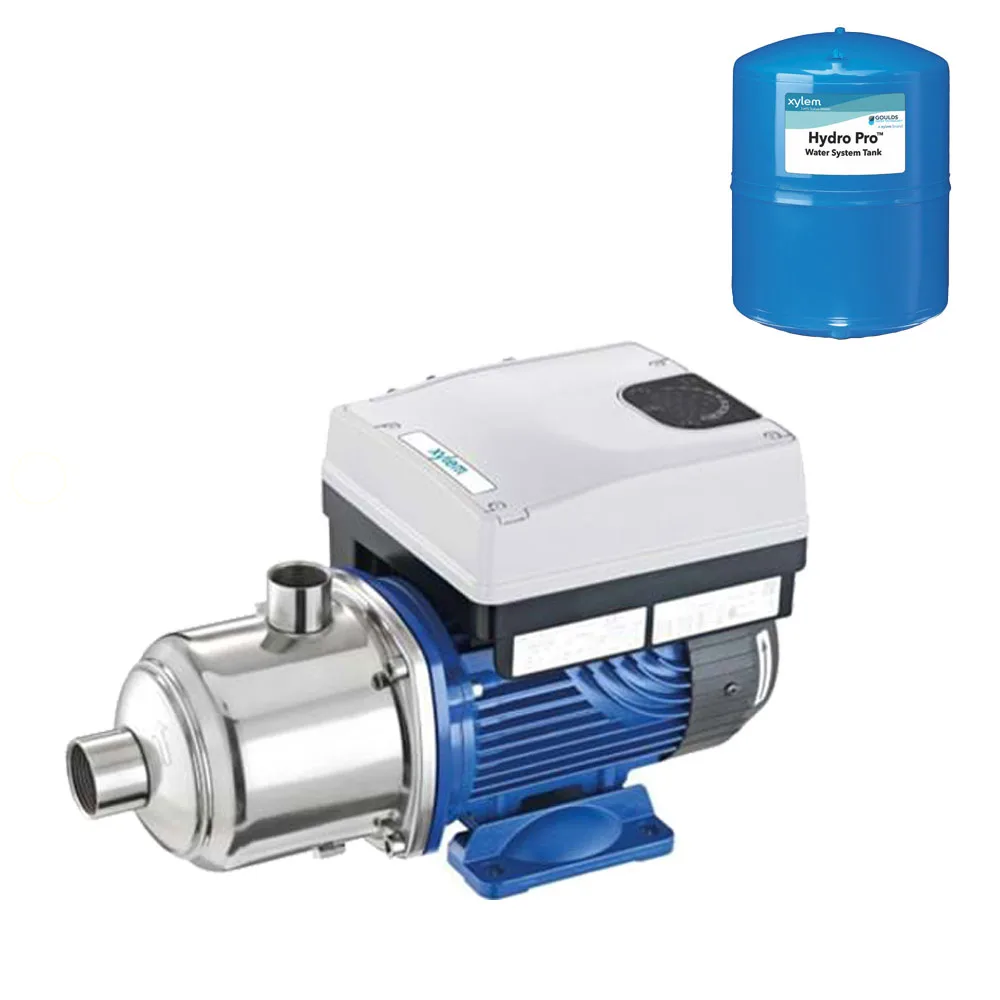
What a Goulds VFD Does for a Centrifugal Pump
A Goulds VFD (variable frequency drive) changes motor speed so a centrifugal pump follows the system instead of running flat-out against a throttled valve. Goulds Water Technology sells that capability under the Aquavar and Hydrovar names: wall-mount controllers, packaged booster sets, and motor-mounted drives. The point is not a fancier starter. It is matching flow and head to demand, then protecting the pump when the system goes wrong.
Xylem's current Goulds Water Technology drive brochure (BRCPVFD R11, November 2025) describes the drive the way field techs actually use it: the pressure or flow sensor is the speedometer, and the drive is cruise control. You set a target. The drive varies frequency (and therefore RPM) so the pump holds that target as fixtures open, a cooling coil calls, or a well recovers. If you still size from a single 60 Hz curve, read how to read pump curves first. A VFD does not replace the curve. It gives you a family of curves, one per speed.
We stock the current Goulds Water Technology drive families on this site. The 2016 names that still float around the internet (CPC, SPD, AquaBoost II, SoloBoost) are not the lineup Xylem is publishing today. Use this page to pick the current family, then we will match the exact enclosure, horsepower, and motor.
Confirm the Duty Is Variable
If flow or head actually changes through the day, a drive can save energy and hold pressure. If the pump must sit on one duty point all day, stay fixed-speed.
Pick the Current Family
Packaged booster (e-AB3, e-AB2, ResiBoost), well-pump controller (SOLO 2), wall-mount (Aquavar IPC), or motor-mount (Hydrovar / Hydrovar X).
Match Motor and Power
Input phase and voltage, output phase, motor insulation, and (for submersibles) an output filter. Wrong pairing kills motors faster than a cheap starter ever did.
Energy follows the cube
On a centrifugal pump, power drops with the cube of speed. Xylem's drive brochure states a 16% speed cut yields about a 42% horsepower cut. That is the payback case, when the system curve is mostly friction.
Protections a starter cannot offer
The same brochure lists overcurrent, short circuit, ground fault, dry-run, overpressure, and broken-pipe shutdown. Those are pump and system faults, not just motor overloads.
Constant pressure without a huge tank
A transducer tells the drive to speed up as demand rises. Packaged Aquavar boosters ship with a small bladder tank (2 or 5 gallon on e-AB3 kits) instead of a large hydropneumatic tank.
Start with the job, not the catalog page. A wall-mount Aquavar IPC on an existing e-SV is a different quote from an e-AB3 packaged smart pump on a municipal tap. If you only know "I need a Goulds Aquavar," send the duty (GPM, boost PSI, voltage, phase) and we will pick the family.
Affinity Laws: Why a Variable Speed Pump Drive Saves Energy
The pump vfd benefits that show up on a utility bill come from the affinity laws. For a centrifugal pump with the same impeller diameter, flow scales with speed, head with speed squared, and power with speed cubed. Xylem prints the same relationships in BRCPVFD R11. They are textbook hydraulics, not marketing.
Flow2 / Flow1 = RPM2 / RPM1 | Head2 / Head1 = (RPM2 / RPM1) squared | HP2 / HP1 = (RPM2 / RPM1) cubed
Worked from those identities, a drop from 60 Hz to 50 Hz (about 3450 to 2875 RPM on a 2-pole motor) should land near 0.83 flow, 0.69 head, and 0.58 power. That is exactly the multiplier table Xylem publishes in the same brochure. Two independent statements of the same math: the identities, and the printed table.
60 Hz
RPM: 3450
Flow: 1.00
Head: 1.00
Power: 1.00
50 Hz
RPM: 2875
Flow: 0.83
Head: 0.69
Power: 0.58
40 Hz
RPM: 2300
Flow: 0.67
Head: 0.44
Power: 0.30
30 Hz
RPM: 1725
Flow: 0.50
Head: 0.25
Power: 0.125
Multipliers from Xylem Goulds Water Technology BRCPVFD R11 (November 2025). They match the standard affinity-law identities for a centrifugal pump at constant impeller diameter.
High static head shrinks the savings
The cube law assumes most of the head is friction. If most of the head is lift or a pressurized vessel (a tall building, a boiler, a well with deep pumping level), the pump still has to make that static head at every speed. The drive can still hold pressure and soften starts. It will not cut the bill the way a friction-dominated booster does. Plot the system curve on the pump curve before you sell the energy story. How to read pump curves covers that overlay.
The Current Goulds Aquavar Lineup
Xylem's November 2025 variable-speed brochure is the lineup we use for selection. The current Goulds Aquavar and Hydrovar families are IPC, SOLO 2, the e-AB series (e-AB2 and e-AB3), ResiBoost, AquaCase, motor-mounted Hydrovar, and Hydrovar X smart pumps. If a 2016 blog or a dusty submittal still says CPC, SPD, or AquaBoost II, treat those as predecessor names. We still list some of those SKUs for replacements. We do not start a new design there.
Type: Wall- or base-mount pump VFD for speed, pressure, flow, or level
Range: 1.5-600 HP overall; 1.5-30 HP on 1-phase 208-240 V; 1.5-60 HP on 3-phase 208-240 V; 1.5-600 HP on 3-phase 380-480 V and 525-600 V. Ambient 14 °F to 113 °F (derate to 122 °F). Multi-pump to 4 drives.
Use when: Existing centrifugal or submersible (with a DV/DT filter), commercial booster, HVAC, or any job that needs a real keypad and Genie setup
Aquavar SOLO 2
Type: Dedicated constant-pressure controller for 4-inch submersible well pumps
Range: 1-phase 230 V input. 1AS15: 1/2 to 2 HP, 1-phase out (2 HP motors must be 3-wire). 3AS20: 3/4 to 2 HP, 3-phase out. 3AS50: 3 to 5 HP, 3-phase out. NEMA 3R. Setpoint 20-85 psi on the standard 100 psi sensor (3AS50 uses a 200 psi sensor, 20-100 psi).
Use when: Residential, irrigation, or greenhouse well that must hold pressure as fixtures cycle
Type: Packaged smart-pump booster: e-HM + Xylem Smart Motor (IE5) + tank + tee
Range: 1/2 to 2 HP, 208-230 V 1-phase in. Flows to 75 GPM / heads to 290 ft in the e-AB3 brochure. Setpoint 20-85 psi. NEMA 3R. NSF/ANSI 61 and 372.
Use when: Municipal low-pressure tap or storage-tank boost on a house or small building
Type: Packaged booster: Aquavar IPC + e-HM, MCS, or HSC; 1-phase in, 3-phase out
Range: 3 and 5 HP IPC packages in BAQUAeAB2 R8; BRCPVFD R11 also lists 1 and 2 HP e-AB2 configurations. Xylem states up to 80 GPM at 70 psi boost on the 3-5 HP e-AB2 (light commercial to 100 GPM at 55 psi boost in BAQUAeAB2 R8). NEMA 1 or 3R.
Use when: Larger residential or light-commercial boost where a 3 or 5 HP three-phase motor is acceptable
Type: Factory-programmed package: small VFD + stainless multistage + bladder tank
Range: Catalog examples: 13159RB115 is 1 HP, 115 V, 13 GPM at 60 psi, 22 GPM max; 13120RB230 is 3/4 HP, 230 V, 13 GPM at 48 psi, 22 GPM max.
Use when: Tight closet or simple municipal boost where plug-and-play matters more than a 5 HP IPC
Hydrovar / Hydrovar X
Type: Motor-mounted VFD (Hydrovar) or IE5 integrated smart motor (Hydrovar X)
Range: Hydrovar: 2-30 HP (2-5 HP 1-phase 208-240 V; 2-15 HP 3-phase 208-240 V; 2-30 HP 3-phase 380-460 V). Hydrovar X: multi-pump to 8, IP55, -4 °F to 122 °F. Catalog smart-pump series: e-SVX, e-HMX, e-SHX.
Use when: Retrofit on a TEFC motor, or a new skid that should ship as one intelligent pump
HP and voltage ranges: Aquavar IPC and Hydrovar from the Goulds Water Technology industrial brochure plus BRCPVFD R11. SOLO 2 from GWT-BAQSOLO2 R7 and catalog rows 1AS15 / 3AS20 / 3AS50AQ. e-AB3 from BAQeAB3 and catalog 1AB31HME04/06 and 2AB35HME05. e-AB2 from BAQUAeAB2 R8 and BRCPVFD R11. ResiBoost from catalog specs, which match the BRCPVFD R11 capacity table.
What we actually carry under /goulds
The manufacturer page is Goulds Water Technology. Drive and packaged-booster series live as their own nodes. Controllers as a pump type sit at Controllers.
The current wall-mount Goulds VFD. Example 3 HP, 1-phase 230 V, NEMA 3R with transducer: AVA10030C0F0X0X1 (10.6 A). Same rating, NEMA 1: AVA10030A0F0X0X1. 5 HP NEMA 3R: AVA10050C0F0X0X1 (16.7 A). Those amp ratings match BAQUAeAB2 R8.
Keypads, option cards, and service parts for an installed IPC. Quote the full model string off the drive nameplate. The AVA code encodes enclosure, HP, and filter.
Seven published kits. 1AB31HME06 is 3/4 HP, 230 V, e-HM 6-stage, V6P tank, 1 in x 1 in. 2AB35HME05 is 2 HP, 230 V, e-HM 5-stage, V15P tank. Both match BAQeAB3.
The catalog node is still labeled e-ABII. Current 3 HP IPC packages live here, including 3AVN15HM07 (NEMA 1) and 3AVN110HM03, which are the BAQUAeAB2 R8 3 HP e-HM selections.
Motor-mount HVM units for TEFC retrofits, plus the Hydrovar X smart-pump families e-SVX, e-HMX, and e-SHX.
Small residential packages. AquaCase is a separate one-SKU node at AquaCase (dual-voltage 115/230 V, NEMA 3R, Wi-Fi per BRCPVFD R11).
SOLO 2 is current. It is just filed oddly. Xylem still publishes SOLO 2 as the well-pump Aquavar. On this site the controllers land under Wastewater Accessories until that node is retitled: 1AS15 (1/2 to 2 HP, 2- or 3-wire; 2 HP motors must be 3-wire), 3AS20 (3/4 to 2 HP, 3-phase motor), 3AS50AQ (3 to 5 HP with Wi-Fi kit). There is no dedicated /goulds/solo-2 series page today.
Constant-Pressure Jobs: Booster, Well, and HVAC
Most Aquavar quotes we write are constant-pressure. The transducer closes the loop. The drive speeds up when pressure sags and sleeps when demand is zero. The hydraulics still have to be right. A VFD cannot invent head the pump does not have at the reduced speed.
Municipal or tank booster
Low city pressure or a storage tank that needs a lift into the building. e-AB3 (1/2-2 HP smart pump) and e-AB2 (3-5 HP IPC package) are the current Goulds answers. BAQeAB3 is explicit: PSI on the selection chart is boost, not total system pressure. Size the pump for incoming pressure plus the boost, then cap the setpoint (e-AB3 literature: do not set required system pressure above 85 psi).
Submersible well
SOLO 2 is the current dedicated well controller: 230 V 1-phase in, built-in output filter, 4-inch motor tables for Goulds, Pentek XE, Franklin, and Grundfos. BAQeAB3 and BAQUAeAB2 both say the same thing: for submersibles use SOLO 2 (or S-Drive in those older notes), or use Aquavar IPC with a DV/DT filter. We stock those filters at CentriPro DV/DT.
We do not currently have a Goulds GS 4-inch well-pump series node in this catalog. If you are pairing a SOLO 2 with a water end, send the motor HP, SFA, and whether it is 2-wire or 3-wire.
HVAC and commercial building
Circulation and booster loops that already use 3656/3756, e-SV, or MCS. Hydrovar mounts on a TEFC motor. Hydrovar X ships as e-SVX / e-HMX / e-SHX. IPC covers 1.5-600 HP when the motor is across the room from the drive. The industrial brochure attributes up to 70% energy reduction versus fixed speed when an e-SV is paired with Hydrovar or Aquavar IPC. Treat that as a Xylem claim, not a guarantee for every coil loop.
Booster vs well is not a firmware checkbox
An e-AB3 on a municipal tap sees flooded suction. A SOLO 2 on a well sees a long motor lead, a recovering water level, and a 4-inch motor that does not like reflected PWM. That is why Xylem puts a filter in SOLO 2 and requires a DV/DT accessory on IPC for submersibles. Do not drop a booster IPC onto a well motor to save a line item.
Sizing and Selection: Motor, Phase, and Filters
Pick the pump on the duty point first (GPM and total dynamic head, including incoming pressure on a booster). Then pick the drive so the motor, incoming power, and environment fit. A 5 HP IPC cannot rescue a pump that is already past runout at 60 Hz.
Fix the Duty Point
Required GPM at the fixture group or coil, plus TDH (static + friction + pressure). For boosters, incoming city or tank pressure is part of the math. Then read the curve at the speeds you will actually run.
Read the Motor Nameplate
HP, voltage, phase, FLA, service-factor amps, insulation class, enclosure (ODP vs TEFC), and whether it is 2-wire or 3-wire on a 4-inch submersible. SOLO 2 sets current limit to SFA, not FLA.
Choose Enclosure and Options
NEMA 1 indoor vs NEMA 3R outdoor on IPC and e-AB2. Transducer range. Multi-pump (IPC to 4, Hydrovar / Hydrovar X to 8, Smart Motor to 3). DV/DT filter on submersible IPC jobs.
Single-phase input, three-phase output
This is the feature that sells a lot of Aquavar jobs in buildings that only have 230 V single-phase service. The drive takes 1-phase in and synthesizes 3-phase out so you can run a three-phase motor (smoother, often cheaper, no start capacitor). That is how e-AB2 is built: BAQUAeAB2 R8 states every listed 3 and 5 HP package is 208-230 V 1-phase in and 230 V 3-phase out, and every pump on those packages has a three-phase motor.
SOLO 2 1AS15
Input: 1-phase 230 V
Output: 1-phase, variable voltage/frequency, 30-60 Hz only
Watch: 2-wire motors top out at 1-1/2 HP; 2 HP must be 3-wire, and 2 HP Franklin/Grundfos 3-wire motors will current-limit (GWT-BAQSOLO2 R7)
SOLO 2 3AS20 / 3AS30 / 3AS50
Input: 1-phase 230 V
Output: 3-phase to the 4-inch motor; 3AS models can run 30-80 Hz on a mismatched water end
Watch: 5 HP motors may exceed the overload range and current-limit
e-AB3
Input: 1-phase 208-230 V
Output: Integrated Smart Motor (not a separate 3-phase motor you supply)
Watch: Smart Motor is not sold separately (BRCPVFD R11)
e-AB2 (3 and 5 HP)
Input: 1-phase 200-240 V ±10%
Output: 3-phase up to 230 V; 10.6 A (3 HP) or 16.7 A (5 HP)
Watch: You are buying a 3-phase motor even if the building is 1-phase
Aquavar IPC (full line)
Input: 1-phase 200-240 V, or 3-phase 200-240 / 380-480 / 525-600 V
Output: 3-phase, 0 V to input voltage
Watch: 1-phase input tops out at 30 HP in the industrial brochure
Hydrovar
Input: 1-phase 208-240 V (2-5 HP) or 3-phase
Output: Mounted on a 3-phase TEFC motor, Class F, NEMA A or B (BRCPVFD R11 motor note)
Watch: Needs a TEFC fan cover. ODP and most submersibles are the wrong target.
What we need to quote a Goulds drive
Send this list and we can pick IPC vs SOLO 2 vs a packaged booster without a second phone call.
Submersible motors need a filter (or SOLO 2)
PWM output plus a long well cable reflects voltage spikes into the motor windings. BAQeAB3 and BAQUAeAB2 R8 both tell you to use Aquavar SOLO 2 (filter built in) or Aquavar IPC plus a DV/DT filter on submersibles. We carry CentriPro DV/DT output filters. Skipping the filter to hit a price is how you buy a motor twice.
When a VFD Is Not Worth It
A drive is a real piece of electronics with heat, harmonics, and a firmware menu. If the process never turns down, you paid for a box that sits at 60 Hz and adds failure modes. We walk away from VFD quotes when the duty does not support one.
A Goulds VFD is the right spend
Demand swings through the day (boost, irrigation, HVAC). You want constant pressure without a large tank. You have 1-phase service and need a 3-phase motor. You need soft-start to kill water hammer. You want pump-specific protections (dry run, no-flow, transducer fault) instead of a generic HVAC drive.
Stay across-the-line or use a soft starter
The pump sits on one duty point all shift (batch transfer, a process that always needs design flow). Static head dominates, so the cube-law savings disappear. Horsepower is so small that the drive costs more than a few years of energy. The area is classified and the motor/drive pair is not listed for it. You only need a reduced inrush, not speed control: look at Aquastart instead of a full VFD.
Fixed-speed at BEP already
If the system curve already crosses the pump curve near best efficiency and the load does not move, a VFD becomes an expensive disconnect. Trim the impeller or pick a smaller pump.
Positive-displacement duty
Affinity laws as printed for centrifugals do not apply the same way to a PD pump. Do not put an Aquavar on a metering or progressing-cavity pump because someone said "variable speed."
Need a disconnect, not a drive
If the complaint is hard starts or a generator that sags, a soft starter may be enough. Aquastart is the Goulds combination soft-starter family we list under /goulds.
The catalog leftover is not a recommendation
We still list Aquavar CPC, SPD, SPD Plus, and AquaBoost II. Those pages are for matching an installed unit. New work starts on IPC, SOLO 2, e-AB, or Hydrovar.
Common Goulds VFD Mistakes
Shopping the 2016 name
SoloBoost, CPC, SPD, and AquaBoost II show up in old quotes and in our own 2016 blog. Xylem's 2025 brochure does not present those as the current family. Ask for IPC, SOLO 2, e-AB2/e-AB3, ResiBoost, or Hydrovar X by those names.
Ignoring 1-phase in / 3-phase out
e-AB2 and most IPC 230 V 1-phase units feed a three-phase motor. If you order a 1-phase motor to "match the building," the drive has nothing legal to run. Confirm motor phase on the nameplate before the truck leaves.
IPC on a well without a DV/DT filter
Xylem's e-AB literature is blunt: submersibles get SOLO 2 or IPC plus a DV/DT filter. A long drop cable plus PWM is a motor-insulation problem, not a maybe.
Treating boost PSI as city pressure
e-AB2 and e-AB3 selection charts are boost, not absolute. If the main is already 40 psi and you need 60 psi at the fixture, you are buying 20 psi of boost, not a 60 psi pump. Then respect the 85 psi total-system warning in those brochures.
Selling cube-law savings on a high-static system
A 200 ft lift still has to be lifted. The drive will hold pressure and start softly. It will not cut horsepower to 30% at 40 Hz the way a friction-only booster does.
Frequently Asked Questions
What is a Goulds VFD?
A Goulds VFD is a variable frequency drive sold under the Aquavar and Hydrovar brands from Goulds Water Technology (Xylem). It varies motor speed so a centrifugal pump holds pressure, flow, or level instead of running at full 60 Hz. The current families are Aquavar IPC, Aquavar SOLO 2, the e-AB2/e-AB3 packaged boosters, ResiBoost, AquaCase, motor-mounted Hydrovar, and Hydrovar X smart pumps. Browse them from the Goulds brand page.
What is Goulds Aquavar?
Aquavar is the Goulds name for pump-specific variable speed controls. Today that means the IPC wall-mount drive, the SOLO 2 well-pump controller, and the e-AB packaged constant-pressure boosters. Hydrovar is the motor-mounted sibling. Older names (CPC, SPD, AquaBoost II) still appear as replacement SKUs on this site but are not the current published lineup.
What are the pump VFD benefits on a centrifugal pump?
Energy (power falls with the cube of speed when head is mostly friction), constant pressure without a large tank, soft start, and pump/system protections a starter cannot offer: dry run, no-flow, overpressure, transducer fault. Xylem's BRCPVFD R11 states a 16% speed reduction is about a 42% horsepower reduction. That holds only when the system curve is friction-dominated. See the affinity-law section above and how to read pump curves.
Can a variable speed pump drive run a three-phase motor from single-phase power?
Yes, on the families built for it. Aquavar IPC lists dedicated 1-phase 200-240 V input through 30 HP, with 3-phase output. e-AB2 3 and 5 HP packages are 1-phase in / 3-phase out (10.6 A and 16.7 A). SOLO 2 3AS models take 1-phase 230 V in and feed a 3-phase 4-inch well motor. e-AB3 uses an integrated Smart Motor on 1-phase 208-230 V. Match the exact model. Do not assume every Aquavar converts phase.
Is Aquavar SOLO 2 the same as SoloBoost?
No. SoloBoost is not in Xylem's November 2025 variable-speed brochure. The current well-pump Aquavar is SOLO 2 (GWT-BAQSOLO2 R7): 1AS15 for 1-phase motors, 3AS20/3AS30/3AS50 for 3-phase 4-inch motors. We list those controllers today at 1AS15, 3AS20, and 3AS50AQ.
When is a Goulds VFD not worth it?
When the pump never turns down, when static head dominates the system curve, when you only needed a soft starter (Aquastart), or when the area classification and motor do not have a listed VFD pair. A drive sitting at 60 Hz all day is a heat source and a future service call, not a savings plan.
Get the Drive and the Pump Quoted Together
We would rather spend ten minutes on the nameplate than ship an IPC that cannot talk to the motor you already bought. Call or send the application if any of these are true:
You are replacing a CPC, SPD, or AquaBoost II and need the current cross.
The building is 1-phase 230 V and the pump you want is 3-phase.
The motor is a 4-inch submersible (SOLO 2 vs IPC plus DV/DT).
You need a packaged booster (e-AB3, e-AB2, ResiBoost) versus a loose e-HM and drive.
The job is HVAC or a multi-pump manifold (IPC to 4, Hydrovar X to 8).
You have GPM and boost PSI but no series picked yet.
Talk to a Goulds drive specialist
Send the duty point, incoming power, and the motor nameplate. We will tell you whether you want an Aquavar IPC, a SOLO 2, a packaged e-AB, or a Hydrovar, and we will not sell a drive the affinity laws cannot pay back.