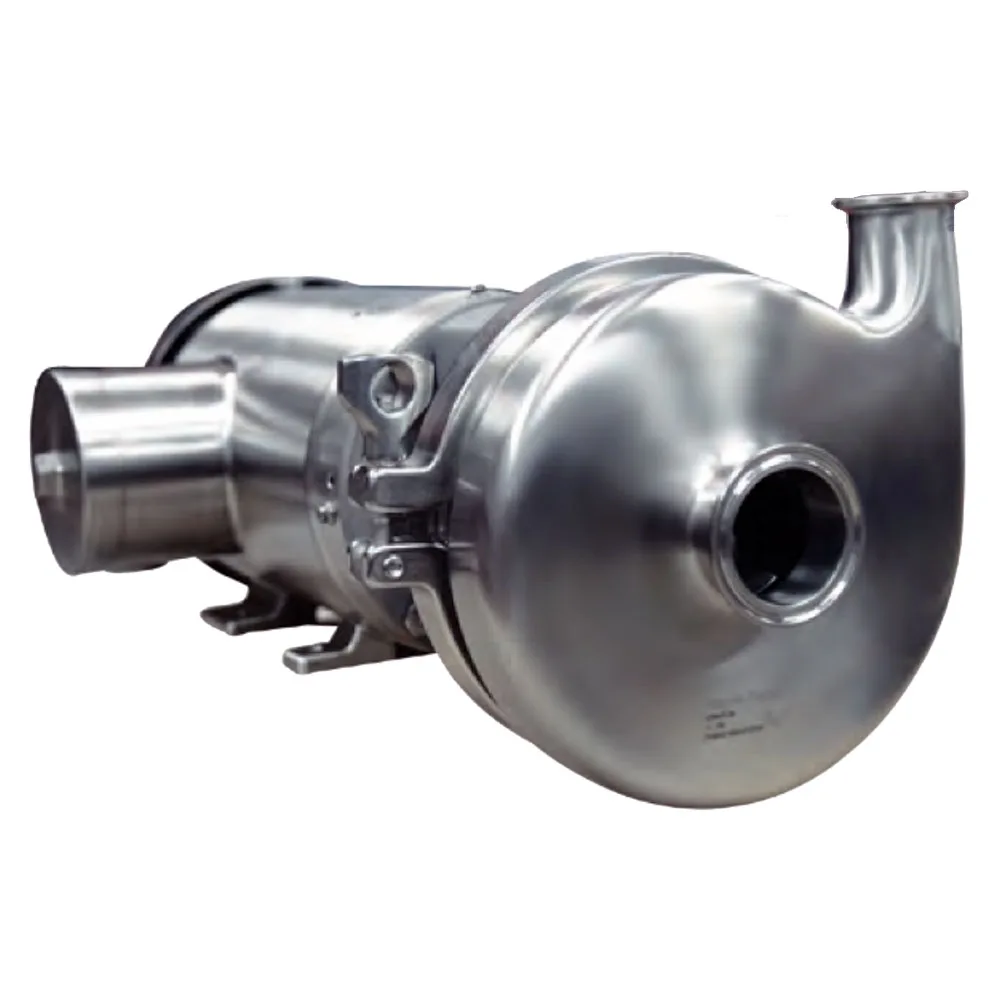
Sanitary Pump Selection for Food Processing Plants
Most food processing pumps fail the spec before they fail in the field. Someone copied a 60 Hz centrifugal curve onto a 50 Hz plant, called a washdown booster a food grade pump, or bought 316 stainless without checking the elastomer. Sanitary pump selection starts with the product (viscosity, temperature, solids, shear), the hygiene rule you actually have to meet (3-A, EHEDG, FDA contact), and the electrical service at the plant, not with a catalog horsepower.
This guide is the path we use when a dairy, beverage, plant-based, or prepared-foods plant sends us a duty. Product-contact duty usually lands on Ampco sanitary centrifugals or ZP / AL positive displacement. Plant water, CIP chemicals that never see product, and washdown often land on Grundfos CR or CM/CME. Those are different jobs. Mixing them is how a 3-A conversation turns into a failed audit.
Browse the live catalog from Food, Beverage and Dairy, the Food, Beverage & Sanitary application tree, or Sanitary Pumps. The pages below tell you which family to open first.
Name the Hygiene Rule
3-A Symbol authorization, EHEDG class, FDA food-contact listing, or plant SOP. Marketing language is not a certificate.
Match Hydraulics to the Product
Thin, clean liquids: sanitary centrifugal. Viscous, shear-sensitive, or metered product: positive displacement.
Lock Frequency and Cleanability
50 Hz vs 60 Hz sets speed, flow, and head. CIP/SIP sets seal, drainability, and whether the pump can stay in the line.
What to send before we quote
One complete packet beats three rounds of clarification.
What 3-A and EHEDG Actually Certify
Neither mark certifies your process, your CIP recipe, or the food leaving the filler. They certify equipment design and cleanability against a published standard. If a salesperson says a pump is "3-A" without a current authorization number, treat that as a claim to verify, not a specification.
3-A Symbol
Covers: Independent Third Party Verification that a listed model conforms to a specific 3-A Sanitary Standard for sanitary design and fabrication (3-A SSI).
Does not cover: Your plant CIP validation, FDA food-contact listing of a random elastomer, or a brochure phrase such as "meets 3A."
EHEDG certificate
Covers: Hygienic design review plus, for closed equipment, cleanability testing. Type EL Class I means wet CIP without dismantling (EHEDG).
Does not cover: A blanket approval of every seal, size, and elastomer in a series. Certificates are configuration-specific.
FDA food-contact listing
Covers: A material (often an elastomer or polymer) listed for repeated-use food contact, e.g. the FDA CFR 21.177 family Wilden cites on Saniflo.
Does not cover: A hygienic-design review of the pump geometry. A listed O-ring in a dead-leg is still a hygiene problem.
Sources: 3-A SSI About the 3-A Symbol and Buyer Beware; EHEDG Certification Types and Classes; Wilden Saniflo HS/FDA brochure.
3-A Symbol authorization
3-A SSI describes the Symbol as a registered mark used since 1956 to identify equipment that meets 3-A Sanitary Standards for design and fabrication. Authorization requires a Certified Conformance Evaluator to run a Third Party Verification inspection. Search the public 3-A certificate database by company, equipment type, or authorization number before you write "3-A" into a PO.
EHEDG Type EL vs ED
EHEDG Type EL is equipment cleaned with liquids. Class I is CIP without dismantling; Class II is dismantled for wet cleaning. EL Aseptic Class I adds steam sterilizable and bacteria-tight. Type ED is dry-cleaned only. Ampco states the ZP3 is EHEDG certified; the brochure does not print the class. Ask for the certificate, not the logo on a flyer.
"Meets 3A" is not a 3-A Symbol
3-A SSI's Buyer Beware page exists because hundreds of listings say "meets 3A," "conforms to 3A," or put 3A in a model name. Those phrases do not mean the equipment holds a current 3-A Symbol authorization. Ampco's AC/AC+ brochure says the pumps "are in compliance with 3A standards." Ampco's website says "3A Certified." Ampco's ZP brochure says ZP3 is "EHEDG Certified and in conformance with 3A Sanitary Standards and the ATEX Directive." We repeat those as manufacturer statements. Confirm the current authorization or certificate number in the 3-A SSI and EHEDG public lists before you treat them as accepted on an audit.
Wilden's Saniflo HS brochure states HS and FDA pumps are engineered to meet or exceed 3-A, FDA CFR 21.177, 1935/2004/EC, and (on HS with PTFE elastomers) USP Class VI, and that HS pumps have 3-A certifications for CIP. Graco's QUANTM Hygienic 3A line is listed under that name in our catalog. Same rule: pull the certificate for the exact configuration.
316L Stainless and Food-Contact Elastomers
A food grade pump is not "any stainless pump." Product-contact metals and elastomers have to match the food, the CIP chemistry, and the temperature. Ampco's AC/AC+ brochure and current product page specify 316L wetted construction (casing, backplate, impeller, stub shaft) with 304 stainless adapters as standard. The AL brochure specifies 316L pump construction and a 304 stainless gear case. ZP housing and cover are 316L; rotors are Alloy 88 (non-galling).
316L is the low-carbon grade plants specify for welded sanitary fabrications. 304 stainless shows up on adapters, gear cases, and some stocked SKUs. That distinction matters. Our catalog includes AC-family rows such as A3U-32-20075T3G built in 304SS with a Type 21 industrial seal. That is not the same spec as AC-216MDG18T-S (316 SS, 2 x 1.5 tri-clamp, Type DG, 3 HP, 60 Hz, 1750 RPM). Read the construction line, not the series name.
Product-contact metal
Published: 316L on Ampco AC/AC+, AL, ZP, L, and CB+ literature. Wilden Saniflo HS: 316L with Ra 0.8 um (32 u-in) interior polish.
Watch: 304SS adapters and gear cases are standard on several Ampco lines. Some catalog SKUs are 304SS throughout.
Elastomers
Published: Stocked Ampco seals and covers in Buna, EPDM, and Viton (FKM). L Series brochure standard: silicon carbide / carbon / Viton. AL catalog SKUs in EPDM or Viton. ZP3-130 stocked with Viton plus Teflon-encapsulated seal.
Watch: Polymer family is not a compound listing. Confirm the FDA food-contact listing and CIP chemical compatibility for the exact compound.
Finish
Published: AL brochure: 32RA (0.8 um) standard, 16RA (0.4 um) optional. ZP catalog rows list 32Ra. Wilden HS: Ra 0.8 um (32 u-in).
Watch: Glass-bead industrial finishes (Ampco IC+) are not a sanitary product-contact finish.
Seal temperature is not casing temperature
Ampco's Type E water-cooled balanced double seal is published for products up to 212 F (brochure and Ampco AC/AC+ page). ZP literature publishes -40 F to +300 F, with hot clearances required at high temperature. D Series CIP/COP pumps are published to 400 F. Those numbers are seal or series limits from the cited literature, not a license to ignore the elastomer or the CIP chemical. If you are near a limit, we size from the model curve and the seal option, not the headline.
Centrifugal vs Positive Displacement by Product Viscosity
Viscosity is the fork in the road. A sanitary centrifugal is the right food grade pump for thin, relatively clean liquids (milk, juice, beer, thin plant-based beverages, CIP solution). A circumferential-piston or rotary-lobe PD pump is the right machine when the product is thick, shear-sensitive, or has to be metered. Ampco publishes the split in the literature: AC/AC+ and L Series centrifugals handle product up to 1200 cP (Ampco AC/AC+ page snapshot and L Series brochure). ZP and AL PD pumps are published from 1 to 1,000,000 cP.
Sanitary centrifugal
High flow, moderate head, continuous transfer. Ampco AC/AC+ (C-series style, 316L, tri-clamp), L Series (LC/LD/LF, gentler hydraulics to 1200 cP), CB+ for wort, SP liquid-ring for CIP return and entrained air. Efficiency falls off as viscosity climbs. Not a metering pump.
AC/AC+ page snapshot: 1,100 GPM max flow, 60 PSI max inlet, 1200 cP. Brochure 3500 RPM composite curve is drawn to 1,000 GPM; page body also cites 920 GPM. Confirm the model curve.
Sanitary positive displacement
Near-constant flow against rising pressure. Ampco ZP circumferential-piston (ZP3 is the CIP-able, EHEDG-stated design) and AL rotary lobe (front-loading seals, self-prime to 12 ft, to 440 GPM in the AL brochure). Wilden Saniflo and Graco QUANTM Hygienic when you need a diaphragm pump for shear-sensitive or solids-laden product.
ZP brochure range: 0.1-648 GPM including XP models, to 500 PSI. Ampco's current ZP page lists 0.1-310 GPM for the core overview. AL dedicated brochure: 440 GPM (line brochure says 450 GPM).
If you are in the gray band (a few hundred cP), we look at shear, discharge pressure, and whether you need a predictable displacement per revolution. A bigger centrifugal motor does not fix viscosity. It just heats the product and walks off the curve.
Using a product-contact centrifugal as a CIP return
CIP return is air-handling duty. Ampco's SP liquid-ring and D Series (and the DV double-volute option) are the published CIP-return tools. An AC+ that ran milk all morning is the wrong pump for a stripped, air-laden return line.
Spec'ing PD for a thin, high-flow filler feed
A ZP3 will move water. It is the expensive, low-speed way to do a job an AC-216 or LC does all day. Save the PD for cream, yogurt, syrup, slurry, and anything you would rather not shear.
Calling any stainless centrifugal a sanitary pump
Ampco IC+ shares AC+ hydraulics and 316L, but the brochure says it is intended for non-sanitary service (NPT, Type 21 seal, glass-bead finish). Goulds 316L lines (e-SV, NPE, e-SH) and Finish Thompson mag-drives are industrial or chemical, not a 3-A process pump on this catalog.
50 Hz vs 60 Hz Centrifugal Pumps for Food Plants
This is the question behind the "50 Hz / 60 Hz centrifugal pumps for plant based / prepared / processed food production" searches. Frequency is not a food type. It is the plant electrical service. A 60 Hz motor on a 50 Hz supply does not deliver the published 60 Hz curve. Plant-based beverage, prepared sauces, and processed foods all see the same physics: line frequency sets synchronous speed, and speed sets flow and head.
Synchronous speed for an induction motor is Ns = 120 x f / poles. A 2-pole motor is 3,600 RPM synchronous at 60 Hz and 3,000 RPM synchronous at 50 Hz. A 4-pole motor is 1,800 / 1,500 RPM. Full-load nameplates sit a few percent below that. Our Ampco catalog motors are listed at 3500 RPM, 60 Hz (and 1750 RPM on 4-pole frames). The DC2 CIP pump we stock is 3450 RPM, 60 Hz. Ampco's AC and CB+ brochures publish composite curves at 3500 RPM and 1750 RPM. Grundfos's CR 95-255 data booklet is titled 60 Hz NEMA, 2-pole, 208-230/460 V. The food-processing brochure plots CR curves on a 60 Hz axis.
Flow2 / Flow1 = RPM2 / RPM1 | Head2 / Head1 = (RPM2 / RPM1) squared | Power2 / Power1 = (RPM2 / RPM1) cubed | 50 Hz / 60 Hz on the same 2-pole motor: speed ratio 5/6 | Flow about 83% of the 60 Hz curve; head about 69%
Same pump, 60 Hz to 50 Hz (2-pole)
Result: Speed drops by about one-sixth. Flow drops with speed. Head drops with speed squared. A duty that sat on the 60 Hz curve can fall short on both GPM and PSI.
Spec: Re-select from a 50 Hz curve, or hold speed with a VFD. Do not paste a 60 Hz duty onto a 50 Hz nameplate.
US plant, 60 Hz, 2-pole vs 4-pole
Result: Ampco AC/CB+ literature and our stocked motors use 3500 RPM (2-pole) and 1750 RPM (4-pole) curve families. Head and flow envelopes change with that speed, not with "food type."
Spec: Pick the RPM family from the duty, then the model (114, 216, 328, 4410, and so on).
International plant, IEC motor
Result: Ampco's sanitary line brochure states NEMA and IEC motors are available for domestic and international markets. Grundfos CR in our library is published as 60 Hz NEMA; 50 Hz CR data is a separate booklet from Grundfos.
Spec: State 50 Hz or 60 Hz, voltage, and NEMA vs IEC on the RFQ. We will not assume 60 Hz because the SKU lives in a US catalog.
Affinity relationships are standard centrifugal-pump laws. Speed ratio uses synchronous 50/60 Hz (120 x f / poles). Confirm nameplate RPM on the motor you buy. Sources: Ampco AC/CB+ brochures; Ampco sanitary line (NEMA/IEC); Grundfos CR 95-255 60 Hz data booklet; Food Processing Pumps brochure (60 Hz curves).
Plant-based and prepared foods do not get a special frequency
If you searched for 50 Hz or 60 Hz centrifugal pumps for plant-based, prepared, or processed food production, the frequency clause is about the country's power grid and the motor, not oat milk vs soup. A plant-based beverage that is thin still wants a sanitary centrifugal sized on the correct Hz curve. A prepared sauce that is viscous still wants a PD pump. We will not sell you a "plant-based 50 Hz pump." We will sell you a sanitary centrifugal or PD, with a 50 Hz or 60 Hz motor, on a verified curve.
A VFD on a 60 Hz motor can run a 50 Hz plant at the speed you need, if the motor is inverter-rated and you size cooling and torque at the reduced frequency. That is a drive conversation, not a reason to ignore the nameplate. If you already have a VFD project, the Goulds Aquavar VFD guide covers affinity-law payback on the industrial/water side. Product-contact sanitary pumps still need the hygiene and elastomer spec first.
CIP and SIP Compatibility
CIP (clean-in-place) and SIP (sterilize-in-place) are different circuits, and they often use different pumps than the product line. Grundfos's food-processing brochure is blunt: because a CIP chemical circuit is never in contact with the actual process, sanitary pumps are not required on that circuit. Those pumps still need stainless and chemical compatibility. They do not need a 3-A product-contact certificate.
Product-contact CIP-able pumps
Stay in the line while you circulate. Ampco states the ZP3 is fully CIP-able without modification or loss of efficiency (front-loading seals, free-drain design). AL is published as front-loading and CIP. Wilden Saniflo HS is the CIP-capable diaphragm family; the FDA series is COP. Confirm drainability, seal flush, and that your CIP velocity actually reaches the cover O-ring.
CIP supply and return
Supply: Ampco D Series is published for cleaning and sanitizing solutions, allowable working pressure to 125 PSI, temperatures to 400 F. Return: SP liquid-ring for entrained air and tank stripping; D Series DV double volute to reduce air binding without an air-relief valve. Plant water and washdown: Grundfos CR / Hydro HP in the food brochure.
SIP is steam. Grundfos's food brochure assigns multistage pumps to boiler feed for SIP, not a claim that every CR is a steam-sterilizable product pump. Ampco publishes a ZP3A aseptic variant; we do not treat standard AC/AC+ or ZP3 as SIP-certified unless the certificate in hand says so. If the spec says SIP, send the steam temperature, hold time, and whether the pump is in the sterile boundary.
See Clean-in-Place (CIP) Systems for the application node, and Grundfos DDA/DDE when the job is dosing detergent, peracetic acid, or hypochlorite into the CIP skid. The food brochure lists DDA to 52.8 gph and 232 PSI, DDE to 52.8 gph and 145 PSI.
The Food-Grade Pump Lineup We Stock
These are the live catalog families we open for food and beverage, not a manufacturer wish list. Counts below are published products on the pump-catalog storefront in the authoring database.
C-series style workhorse. 316L, tri-clamp, Type D / DG / E seals. Models 114 through 6410. Brochure: 3-A compliance language; 3500 and 1750 RPM curves. We stock complete pumps and pump ends (example: AC-216MDG18T-S). 93 published SKUs in this series node.
Watch for: IC+ uses the same hydraulics but is the industrial, non-sanitary cousin.
Higher-efficiency sanitary centrifugals (LC single seal, LD double, LF front-loading). Published to 1200 cP. SP is the CIP-return / entrained-air liquid-ring. LH is the high-inlet option (line brochure: inlet pressure up to 600 PSI).
The PD line for viscous dairy and prepared foods. ZP3 is the CIP-able, EHEDG- and 3-A-stated design. Stocked examples: ZP3-130-SM-PEO, ZP2-006-SM. Brochure range to 500 PSI and 1,000,000 cP.
Front-loading lobe pumps, 316L, 32RA standard. Dedicated brochure: 440 GPM, self-prime to 12 ft, 1 to 1,000,000 cP. Stocked ALB15-012-12 and ALB34-144-08.
CB+: internal seal for hot wort, 316L, same model sizes as AC/AC+, 3500 RPM / 60 Hz motors on stocked assemblies (example: ACB+114MB140TC-S-3HP). D Series: CIP/COP supply, 125 PSI / 400 F literature; stocked DC2-2.5 X 2 at 3450 RPM, 60 Hz.
CR vertical multistage (food brochure: CR 95-185 more than 1,280 GPM and 1,235 ft; CRXL booklet is the 60 Hz NEMA confirmation). CM/CME compact horizontal multistage for wash and water. DDA/DDE digital dosing for CIP chemicals. These are process-water, boosting, and chemical pumps, not a substitute for an Ampco product-contact pump.
Wilden Saniflo FDA and HS (3-A / FDA CFR 21.177 stated; CIP on HS). QUANTM Hygienic 3A and food-grade electric double-diaphragm. All-Flo FDA / Hygienic.
Goulds and Finish Thompson are on the site. They are not the sanitary process line.
Goulds Water Technology stainless families (e-SV, NPE 316L, e-SH) are industrial and commercial water pumps. Finish Thompson is chemical mag-drive and drum pumps. Neither brand has a 3-A sanitary process node in this catalog. Use them for plant water, chemicals, and drums. Use Ampco, Wilden Saniflo, QUANTM Hygienic, or All-Flo FDA when the pump sees food.
Application Map: Dairy, Beverage, Plant-Based, Prepared Foods
Use this as a start-here map, then confirm viscosity, temperature, and the hygiene mark. Application nodes: Milk and Dairy, Food Processing, Breweries.
Dairy
Product: Milk, whey, buttermilk (thin); cream, ice cream mix, yogurt, curds (thicker)
Pump: Thin: AC/AC+ or L Series centrifugal (Ampco lists dairy on Type D and L Series). Thick: ZP or AL.
Open: Milk and Dairy
Beverage
Plant-based production
Product: Thin alt-milk and juices; protein slurries, oat/soy bases, higher-viscosity blends
Pump: Thin: sanitary centrifugal on the correct 50 Hz or 60 Hz curve. Slurry / high cP: ZP, AL, or hygienic diaphragm.
Open: Food Processing
Prepared / processed foods
Product: Sauces, fillings, salsa, stews, chocolate, syrups, mashed product, soft solids
Pump: PD first: ZP or AL to 1,000,000 cP. Shear-sensitive solids: Saniflo HS or QUANTM Hygienic. Do not force this through a C-series centrifugal.
Open: Sanitary Pumps
CIP / washdown (no product contact)
Product: Caustics, enzyme cleaners, sanitizer, plant water
Pump: D Series or CR/CM for supply and wash. SP or DV for return. DDA/DDE for chemical dose. Sanitary product-contact cert not required on a circuit that never sees food (Grundfos food brochure).
Open: CIP Systems
Application lists also appear on Ampco AC (dairy, juice, brewing, bottled water) and L Series (dairy, beverages, CIP, oils) brochures. Plant-based is grouped with food processing because it is a viscosity and frequency problem, not a separate pump type.
If you already know the duty point, skip the map and send GPM, TDH or PSI, viscosity, temperature, 50/60 Hz, and the hygiene mark. We will open the series page and the model curve, not a generic "food pump" SKU.
Frequently Asked Questions
What is sanitary pump selection for food processing?
It is matching product-contact materials (typically 316L plus a listed elastomer), a real hygiene mark (3-A Symbol authorization or EHEDG certificate, not a brochure phrase), and the right hydraulic type (centrifugal vs PD) to the duty. Then you lock 50 Hz or 60 Hz and CIP/SIP. Start from the Food, Beverage & Sanitary tree or Ampco if the pump sees food.
What is a food grade pump?
A pump whose product-contact metals and elastomers are suitable for food, and whose geometry can be cleaned to the plant's rule. Stainless alone is not enough. Ampco AC/AC+, L, ZP, AL, and CB+ are the sanitary process families we stock; Wilden Saniflo and Graco QUANTM Hygienic cover diaphragm duty. Goulds 316L water pumps and Finish Thompson chemical pumps are not food-process pumps on this catalog.
What is the difference between 50 Hz and 60 Hz centrifugal pumps?
Line frequency sets motor speed. A 2-pole motor is 3,600 RPM synchronous at 60 Hz and 3,000 RPM at 50 Hz. Flow scales with speed; head scales with speed squared. Moving a 60 Hz centrifugal onto 50 Hz without a VFD or a 50 Hz curve cuts flow to about 83% and head to about 69% of the 60 Hz figures. Our Ampco stock motors are listed at 3500 RPM, 60 Hz; Grundfos CR 95-255 literature in our library is the 60 Hz NEMA booklet.
Are 50 Hz centrifugal pumps used for plant based food production?
Yes, when the plant is on a 50 Hz grid. The product being plant-based does not change the frequency. Thin plant-based beverages still use a sanitary centrifugal sized on a 50 Hz curve (or a VFD holding the needed RPM). Viscous bases and slurries still use a PD pump. Ampco publishes NEMA and IEC motors for domestic and international markets.
Do I need a 3-A certified pump for dairy?
If your inspector, PMO program, or customer spec requires the 3-A Symbol, you need a current authorization for the exact model, not a "conforms to 3A" sentence. Ampco states AC/AC+ compliance / 3-A certified language and states ZP3 is 3-A and EHEDG certified. Verify the authorization number in the 3-A SSI database. FDA elastomer listing is a separate requirement.
Centrifugal or positive displacement for viscous food products?
Positive displacement once you leave the thin-liquid window. Ampco publishes AC/AC+ and L Series centrifugals to 1200 cP, and ZP / AL PD pumps from 1 to 1,000,000 cP. Prepared sauces, fillings, yogurt, and slurries are PD jobs. Thin milk, juice, and beer stay centrifugal.
Send the product, viscosity, temperature, GPM, head or PSI, 50 Hz or 60 Hz, and the hygiene mark you have to pass. Photos of the existing nameplate help when you are replacing a C-series or Universal pump. Our contact form keeps the documents with the request.
Talk to a food-process pump specialist
We stock Ampco sanitary centrifugals and PD pumps, Grundfos CR / CM / dosing for plant water and CIP, and hygienic diaphragm pumps from Wilden and Graco. Tell us the duty and the standard you have to meet. We will match a live catalog configuration, not a brochure family name.